Introduction
AI and Machine learning models may produce potentially biased/unfair results across protected groups, such as race, gender, or age.
Fairness Optimization tool is an AI algorithm that can be incorporated with existing PayPal model development process so that model outcome can be both accurate and fair.
This work proved especially prescient with the EU AI Act classifying credit scoring as "high-risk AI" requiring full compliance by August 2026. The risk management systems, data governance protocols, and explainability frameworks we researched were conducted to comply with the Act's core requirements—from Article 9's risk management to Article 13's transparency mandates, as well as compliance with Executive Order 11411 AI Act.
Methodology
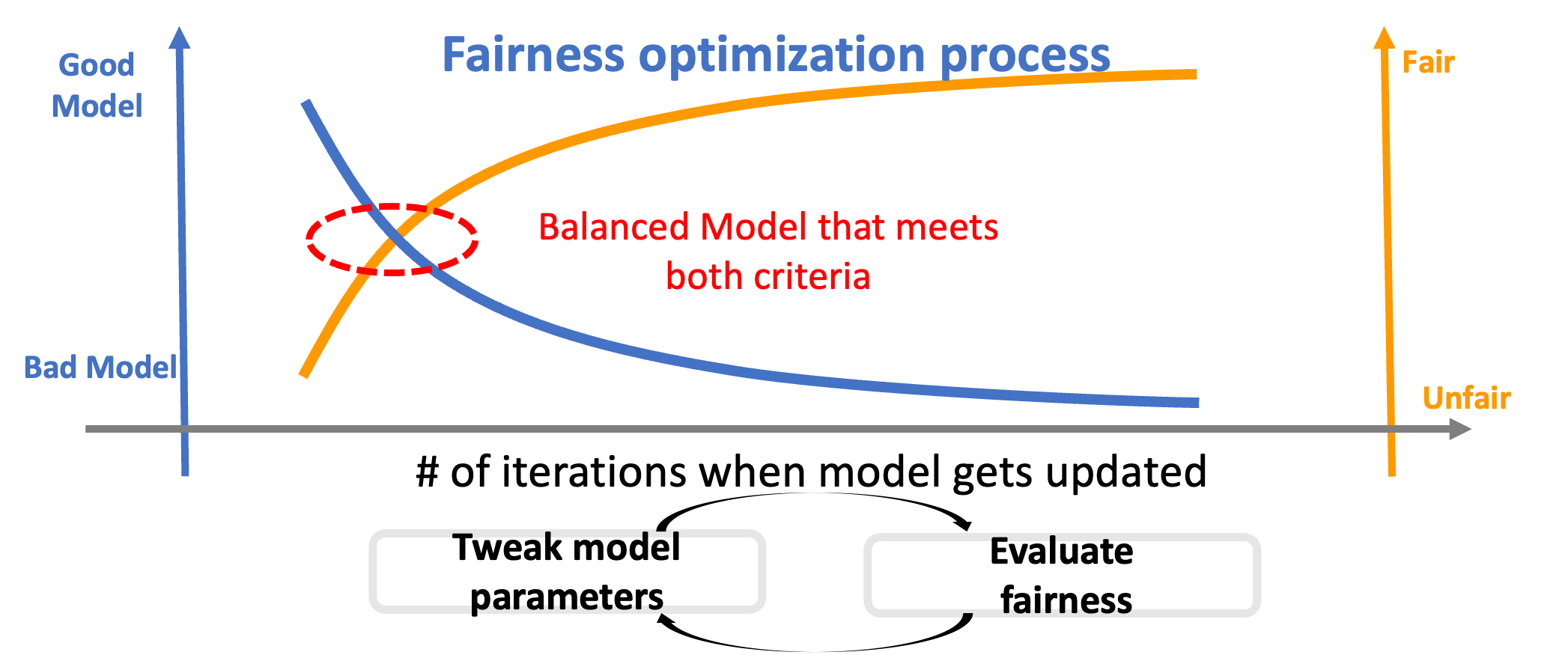
We usually observe that the model performance drops while we bring up the model fairness, thus creating a trade-off.
This phenomenon depends on the model and data, as we have witnessed a few models that do not sacrifice model performance significantly while increasing model fairness.
Benefits
- Tested our tool on 10 different existing PayPal credit models, including credit underwriting and credit fraud detection models. For some of the tested models, we have increased model fairness from 86% to 99%+, while sacrificing <2 KS score from 54 to 52 (model performance).
- Ability to pick out certain variables in the original model that contribute to biased decisions.
- With the tool in the model development pipeline, Legal & Compliance variable review timeline can be reduced by 84% (~5 months), model outcome review reduced by 50% (90 days), and customer impact assessment timeline reduced by 50% (45 days)
Patent Filing
- Patent filing (US20250238688A1) Pending
Limitations and Challenges:
- Wrote the code from scratch from Scikit-learn fairness optimization method (original modeling methodology refenced in this paper: Fair Adversarial Gradient Tree Boosting) to LightGBM model that is used widely in the company by contacting LightGBM devs directly.
- Expanded the capability to debias model outcome on multiple protected groups simultaneously (race, gender, and age), instead of gender only, for example.
- Further study is needed on the trade-off between modularity of the debiasing framework vs the designed-in adversarial models for fairness in the first place. The modularity and adding few weak learners would allow the model to learn/converge faster, but it will most definitely fall into the trap of getting stuck in a local minima. Further monitoring for the decay of the model is necessary.